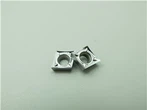
Non-standard tool manufacturers Cemented carbide non-standard tool is a valuable tool, because it is brittle and easy to crack, so it should be light and handy when handling. Do not stack too high to avoid collapse and impact, resulting in missing corners on the edge and affecting use. Many brands and models of cemented carbide non-standard cutting tools can easily be mixed together if they are improperly maintained. If the blade brand is not clean, you can identify them by the following methods:
1. Clear brand mark is printed on the blade: it can be distinguished according to the brand mark area on the blade.
Second, according to the color difference on the blade: If there is no brand mark on the blade or coated with various colors of paint, it can be distinguished by color.
The non-standard tool manufacturer's cemented carbide non-standard tool wears. In order to develop new tool materials, to eliminate and control the wear of the tool, it is necessary to learn the causes and nature of the tool wear.
Tool wear in the cutting process has the following characteristics: the war between the tool and the chip, the appearance of the workpiece is usually rare; the pressure of the war is very high, and the yield strength of the material that crosses the cut is occasionally higher than the yield strength of the material that is cut; The appearance temperature for carbide tools is as high as 800,000C, and it rises to 300,600C for high-speed steel cutting.
Under the above conditions, tool wear is usually the result of the combined use of mechanics, heat, chemistry, and three effects, which can breed wear. Cold welding wear is called adhesive wear, diffusion wear and oxidative wear in some literature. Abrasive wear. French fries, although the hardness of the workpiece is less than the hardness of the thing, but its layout usually contains some very hard particles with low hardness, the motor cuts grooves on the surface of the thing, which is abrasive wear.
The CNC lathe of hard particles has carbides, nitrides, oxides, etc.) and intermetallic compounds. Abrasive wear exists in various cutting speeds, and low-speed cutting tools (such as broaches, molds, etc.) are urgently due to abrasive wear. This is because when cutting at low speed, the cutting temperature is relatively low, but it is caused by other reasons, so it is not an emergency. High-speed steel cuts things like carbides, ceramics, etc., so the proportion of abrasive wear is lower than the hardness and wear resistance.
Generally speaking, for workpiece materials or chips with a hardness lower than the hardness of the tool materials, the cold welding wire breakage usually breeds workpieces or chips on this side. However, due to alternating stress, frustration, thermal stress and the layout defects of the east and west appearances and other reasons, the cold-welded CNC lathe can also breed things on this side. At this time, the motor is at the border of the tool material. Chip or workpiece, tool wear. Cold welding wear is usually more urgent at lower cutting speeds. Studies have shown that brittle metals are more resistant to cold welding than plastic metals.