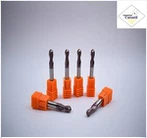
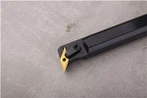
Alloy milling cutters are suitable for safe storage and transportation of CNC center tools. Various tool holders can be placed on the front, back and top three sides. They can be cleaned with a damp cloth, and then wiped off with a dry cloth. The parts that are not easy to clean can be spitted with toothpaste. Clean again.
Alloy milling cutter is a general term for thin circular cutters used to cut solid materials. Saw blades can be divided into: diamond saw blades for cutting stone; high-speed steel saw blades for cutting metal materials (not inlaid with carbide blades); used for solid wood, furniture, wood-based panels, aluminum alloys, Carbide saw blades for cutting aluminum profiles, radiators, plastics, plastic steel, etc. Cemented carbide saw blades include various parameters such as the variety of alloy blades, the raw material of the base body, the diameter, the number of teeth, the thickness, the tooth profile, the viewpoint, the aperture, etc. These parameters determine the processing capacity and cutting function of the saw blade. When selecting a saw blade, the saw blade should be selected correctly according to the type of sawing material, thickness, sawing speed, sawing direction, feeding speed, and sawing road width.
Selection of alloy milling cutter varieties Commonly used varieties of cemented carbide are tungsten-cobalt type and tungsten-titanium type. Because tungsten-cobalt-based cemented carbide has better impact resistance, it is more widely used in wood processing. With the addition of cobalt content, the impact resistance and bending strength of the alloy milling cutter have been improved, but the hardness and wear resistance have been reduced, and the selection should be based on the actual situation.
The number of teeth selected for alloy milling cutters. Generally speaking, the more teeth, the more cutting edges can be cut per unit time, the better the cutting function. However, the larger the number of cutting teeth, the larger the number of carbides, the more the price of the saw blade. High, but the saw teeth are too dense, and the amount of chip between the teeth becomes small, which simply causes the saw blade to heat up; in addition, if there are too many saw teeth, when the feed rate is not matched, the amount of cutting per tooth is small, which will aggravate the gap between the cutting edge and the workpiece. Friction affects the service life of the blade. Usually the tooth spacing is 15-25mm, and a reasonable number of teeth should be selected according to the sawing data. The thickness of the selection of the thickness of the saw blade theoretically we hope that the thinner the saw blade is, the better, the sawing is actually a cost.
The material of the alloy milling cutter matrix and the process of making the saw blade determine the thickness of the saw blade. If the thickness is too thin, the saw blade is simply shaken during operation, which affects the cutting effect. When selecting the thickness of the saw blade, the stability of the saw blade operation and the sawing data should be considered. The thickness required for some special-purpose materials is also specific and should be used according to equipment requirements, such as slotting saw blades, scribing saw blades, etc.
Compared with the high-speed steel saw blade tungsten steel milling cutter, the alloy milling cutter can realize high-speed milling with high processing efficiency. Spiral-tooth coarse-tooth milling cutter has a small number of teeth, high-tooth strength and high chip-capacity space. It is suitable for roughing and fine-tooth milling cutters for finishing. When choosing a saw blade, because the primary material is composed of tungsten steel, it is also called a tungsten steel saw blade. Cemented carbide saw blades include multiple parameters such as the type of alloy blade, the material of the substrate, the diameter, the number of teeth, the thickness, the tooth profile, the angle, and the aperture. These parameters determine the processing capacity and cutting performance of the saw blade. In addition, there are keyway milling cutters, dovetail milling cutters, t-slot milling cutters and various forming milling cutters. Alloy milling cutters are used for machining grooves and step surfaces, etc. When the teeth work on the circumference and end surfaces, they cannot feed along the axial direction.