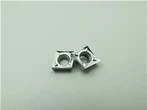
Alloy milling cutter is currently one of the advanced domestic tools. Under the premise of giving full play to its advantages, its production cost is considered low. Therefore, the number of users who use it to replace high-speed steel milling cutters has grown rapidly in recent years. , The following editor will focus on its information.
Alloy milling cutters are commonly used cutting tools for processing wood products. The quality of cemented carbide milling cutters is closely related to the quality of processed products. The correct and reasonable selection of cemented carbide milling cutters is of great significance for improving product quality, shortening the processing cycle, and reducing processing costs. Alloy milling cutters have many advantages, but because cemented carbide itself is less tough than high-speed steel, it is easy to chip when the cutting process is improperly selected or the accuracy of the machine tool is poor. How to make full use of its strengths and avoid weaknesses to give full play to its advantages? There is a question of how to use it correctly.
The thinner the alloy milling cutter is, the more sensitive it is to vibration and tensile stress during use. Large radial runout or axial runout is likely to cause damage, so the milling machine should run in a good state, that is, the machine tool has high precision and good rigidity. , The transmission is stable, the feed rate per tooth is constant, and the cooling is sufficient.
The characteristics of alloy milling cutter cutting process
Milling processing is a widely used processing method in the precision instrument industry. In the cutting process of alloy milling cutter, there are the following characteristics:
1. The cutting part of an alloy milling cutter is composed of one or several cutter teeth, which are distributed on the surface or end face of the rotating body. When cutting, they are intermittent. Therefore, the cutter teeth bear periodic impact force, which is easy to make the tool tip Crumbled.
2. In the cutting process, whether it is down milling or up milling, the thickness of the chip changes. Therefore, the cutting force during the cutting process also changes, and it is periodic, so it is easy to cause the vibration of the process system.
According to the above characteristics, in order to make the milling smooth and to ensure the normal operation of the cutter teeth, reasonable structural parameters and geometric parameters must be selected. The selection of structural parameters and geometric parameters of alloy milling cutters is more complicated than other cutters.
How to maintain the alloy milling cutter?
1. Check the power and rigidity of the machine tool to ensure that the required milling cutter diameter can be used on the machine tool.
2. The overhang of the tool on the spindle is as short as possible to reduce the impact of the milling cutter axis and the position of the workpiece on the impact load.
3. The alloy milling cutter adopts the correct tooth pitch of the milling cutter suitable for the process to ensure that there are not too many blades meshing with the workpiece at the same time to cause vibration during cutting. On the other hand, it is necessary to ensure that there are milling narrow workpieces or milling cavities. Enough blades engage with the workpiece.
4. Make sure to use the feed per blade so that the correct cutting effect can be obtained when the chip is thick enough to reduce tool wear. The indexable inserts with positive rake angle grooves are used to obtain smooth cutting results and low power.
5. Select the diameter of the milling cutter suitable for the width of the workpiece.
6. Choose the correct entering angle.
7. Place the milling cutter correctly.
8. Use cutting fluid only when necessary.
9. Follow the tool maintenance and repair rules, and monitor tool wear.