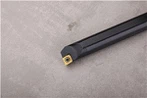
Cemented carbide inserts are tools used for cutting in mechanical manufacturing, also known as cutting tools. The development of mechanical blades occupies an important position in the history of human progress, and cemented carbide blades have played a big role in the history of modern industrial development.
When alloy tool steel is used as the material, the cutting speed of the blade is increased to about 8 m/min. When high-speed steel is used, it is increased by more than two times. When cemented carbide is used, it is more than two times higher than that of high-speed steel. The surface quality and dimensional accuracy of the workpieces processed by cutting are also greatly improved.
According to the cutting motion mode and the corresponding blade shape, cemented carbide inserts can be divided into three categories. General-purpose mechanical blades, such as turning tools, planers, milling cutters (not including shaped turning tools, shaped planers and shaped milling cutters), boring cutters, drill bits, reamers, reamers, saw blades, etc.
The stoppage of any cemented carbide blade means a stoppage in production, but this does not mean that every blade has the same important status. The blade with the longest cutting time has a greater impact on the production cycle, so under the same premise, more attention should be paid to this carbide blade. In addition, the most stringent carbide inserts are required for processing key components and processing tolerances.
Processing hard alloy blades is a very logical task. Every new project is like a reasoning question. You need to use deduction and induction to get the most suitable product. In short, it is a continuous disassembly and integration. the process of. We must disassemble this thing into as small as possible, detailed attributes, each attribute has an impact on the design of cemented carbide blades, sum up these effects, you can get the product you need.