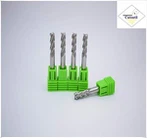
Cemented carbide inserts are the most widely used type of high-speed machining cutting inserts in the machinery production industry. Cemented carbides are produced through powder metallurgy and are combined with hard carbide (usually tungsten carbide WC) particles and softer metal. Agent composition. The use of cemented carbide blade processing can bring better surface roughness to users. Cemented carbide blades have strong impact resistance, the blades will not suddenly break, and it is safer to use.
At present, there are hundreds of different compositions of cemented carbide blades, most of them use cobalt as a binder, nickel and chromium are also commonly used binder elements, and other alloying elements can be added. Why are there so many carbide grades? How does a cemented carbide insert manufacturer choose the right insert material for a particular cutting process?
The quality of cemented carbide blade materials is the basic factor that affects the surface quality, cutting efficiency, and blade life. When cutting, the cutting part of the insert is directly responsible for the cutting work. The cutting performance of the blade mostly depends on the material that constitutes the cutting part of the blade, the geometric parameters of the cutting part, and the selection and design of the round blade structure.
The productivity and durability of the carbide inserts during cutting, the consumption and processing cost of the inserts, the processing accuracy and surface quality, etc., depend to a large extent on the reasonable choice of insert materials. Choosing cemented carbide blade materials is one of the important contents of the design and selection of blades.
Hardness is the basic characteristic of carbide blade materials. To cut chips from the workpiece, the hardness of the carbide blade must be greater than the hardness of the workpiece material. The second is the heat resistance of cemented carbide blades, which is the main indicator to measure the cutting performance of blade materials. It refers to the performance of the blade material to maintain a certain degree of hardness, wear resistance, strength and toughness under high temperature conditions.
In many cases, finished parts need to be coated. The coating can provide the lubricity and increase the hardness of the cemented carbide blade, and can also provide a diffusion barrier for the substrate to prevent oxidation when exposed to high temperatures. The carbide insert matrix is critical to the performance of the coating.