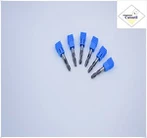
Reasonable tool selection and optimized processing methods are very important for improving processing efficiency and prolonging tool life, especially when processing difficult-to-machine materials aerospace parts. A high-quality tool with difficult-to-machine materials must have an ultra-fine grain tool matrix, a sharp cutting angle, a strong cutting edge, and a heat-resistant surface coating.
First of all, sufficient cooling, appropriate processing line speed, effective chip breaking, and reasonable tool wrap angle are very effective for controlling the tool tip temperature. For CNC machine tools and tools that have internal cooling at the same time, the internal cooling function that is conducive to cooling should be used as much as possible to make the powerful high-pressure water flow away a large amount of cutting heat and ensure that the processing area is kept within a certain temperature range. Even if there is no internal cooling function for machining equipment, it is recommended to use the external transmission and internal cooling of the tool holder, while enhancing the cooling pressure and improving the cooling effect.
Secondly, properly controlling the cutting force and cutting speed of the tool is also one of the effective methods to reduce the temperature of the processing area and extend the life of the carbide insert tool. Generally, the hard-to-machine materials are usually processed with finely ground cutting edges, smaller cutting depths and cutting widths. According to different difficult-to-machine materials, parts structure and processing equipment and other factors, it is very important to select a reasonable cutting linear speed. In normal processing, nickel-based alloys should be controlled at 20-50m/min, titanium alloys should be controlled at 30-110m/min, and PH stainless steels should be controlled at 50-120m/min. Carbide blade
Third, for the same machine tool and parts, the method of processing difficult-to-machine materials will greatly affect the processing efficiency and tool life of the tool. Whether it is cycloid machining, spiral interpolation or high-feed milling, the purpose is to reduce the cutting force and reduce the temperature of the cutting zone. The cycloidal cutting method can greatly reduce the cutting area, so that the actual cutting angle of the tool is small, and the heat dissipation time of each tooth of the tool is prolonged; the spiral interpolation makes the cutting amount of each tooth relatively uniform, especially in the corners; The feed cutting method effectively reduces the cutting force with a small depth of cut and large feed, so that small cutting heat is generated during processing and the temperature of the processing area is extremely low.
Fourth, it is also an effective way to control the temperature rise to ensure that the processing is interrupted. Generally, a large amount of cutting heat is generated on the chips in metal processing, and effective chip breaking will cause a large amount of cutting heat generated during processing to be taken away by the chips. Normally, we don't want long chips to be generated during processing. More attention should be paid to the processing of difficult-to-machine materials, especially for roughing processes. When the rigidity of the entire processing system allows, chip breakage should be generated during the entire processing process, and the up-milling method should be used as much as possible to make the formed iron The scraps become thinner from thickness, and the iron scraps are shaped like "9", "6" or "C".
Fifth, maintain a proper effective tool wrap angle during machining, so that each effective machining tooth of the tool can guarantee a long cooling time to a great extent. Maintaining a proper and reasonable effective tool wrap angle during the processing of cemented carbide inserts is very helpful to improve the cutting efficiency of difficult-to-machine materials and extend the life of the tool. It is extremely important for processing difficult-to-machine material parts. The effective wrap angle of the tool is directly related to the cutting depth Ap, the cutting width Ae and the tool diameter Dc as reflected in the cutting parameters. Especially when processing difficult-to-machine materials, full cutting should be avoided as much as possible. In actual processing, every time the cutting wrap angle of the tool is doubled, the tool life will be reduced by about 30%.
In short, parts of difficult-to-machine materials must have high hardness, high strength, high toughness and high wear resistance. For new difficult-to-machine materials with these characteristics, they have poor machining performance, high machining difficulty, low machining efficiency, and high tool costs. . As a result, parts with difficult-to-machine materials place higher demands on machining tools.