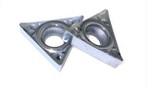
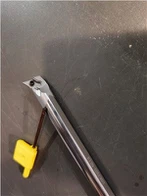
For boring, especially for machining small holes with integral alloy boring bar, the following conditions may be experienced: the boring bar is adjusted to be at or slightly higher than the center line, the diameter of the boring bar is smaller than the aperture, the machining condition looks good, and the machining program is checked without error. After the adjustment is completed and satisfied, press the start button to start processing, and the coolant splashes everywhere; Nothing can be observed until the boring bar retracts from the part.
After boring, the most worrying thing comes true: the boring head is gone!
This situation is usually caused by chip accumulation or boring cutter trying to pass through the bottom of blind hole. If it is found through inspection that the boring head is still in the hole and difficult to take out, the most likely reason is the accumulation of chips in the hole, which leads to this catastrophic failure. The reason for this situation is that cutting parameters such as cutting depth and feed rate are too large, which leads to the material removal rate being greater than chip removal capacity. One of the solutions is to use a boring bar with a smaller diameter. If a boring bar with a smaller diameter cannot be used, the cutting parameters must be reduced to reduce the metal removal rate. If it is found that the broken boring bar is not in the hole or is loose in the hole and difficult to take out, the possible reason is that the boring bar is broken because the depth of the boring feed is greater than the depth of the existing hole on the part. At this time, remember that boring tools cannot drill holes like drill bits.
Tool wear
When the boring cutter is adjusted correctly and there is no catastrophic processing failure, the low production efficiency caused by frequent tool change is unacceptable. Through inspection, it is found that the flank of the cutting edge is excessively worn. However, excessive or rapid wear of the flank can be misdiagnosed. Usually, too long cutting time, intermittent cutting or cutting vibration will cause the cutting edge to collapse, which is regarded as flank wear. The wear of the rake face may be caused by the chip accumulation on the rake face first, because the cutting heat and pressure weld the chips on the rake face of the tool to form the chip accumulation. At a certain moment of cutting, the chips will take away the chip accumulation and the alloy materials on the rake face of the tool.