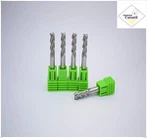
Cemented carbide end mills mainly include integral cemented carbide end mills and indexable cemented carbide insert end mills.
The diameter of integral cemented carbide end mills ranges from 0.2~32mm to 32 mm, but in fact most of them are less than =16mm, because the cost of large diameter raw materials is too high. There are many varieties and specifications of integral cemented carbide end mills (especially ball end mills). In order to meet the needs of die design, most of its front tips are not chamfered at 45 degrees, but are ground to a certain circular arc radius. According to the different cemented carbide grades and the adjustment of tool geometry parameters, there are now end mills with different die hardness ≤ 45hrc, ≤ 55hrc and ≤ 65hrc. Integral cemented carbide end mills with internal cooling have also been applied.
Most of the indexable carbide insert end mills used for die processing have a diameter of 8~50mm, so as to meet the needs of processing smaller cavity shapes of dies. It develops towards small diameter near Ian, and there is an indexable carbide insert ball-end milling cutter with ф 8 mm (r = 4 mm). The end milling cutter with indexable inserts can be made into a longer cutter bar to go deep into the mold cavity for machining, while the overall hard end milling cutter has shorter total length and edge length to improve its rigidity and obtain good surface roughness of the mold cavity instead of grinding and high metal removal rate.
Solid cemented carbide end mills are widely made of ultrafine cemented carbide, with hardness ≥91HRA and bending strength above 3000N/mm2 in some grades, which can fully meet the strong cutting force on the cutting edge of end mills during cutting.
The production of cemented carbide end mills in China is still in its infancy, and the output of the whole cemented carbide end mills is even scarcer. In 2001, the output value and output of all cemented carbide end mills were only 4 million US dollars (200,000 pieces), which was a serious shortage in the production technology of pre-hardening modules.
CNC vertical boring and milling machine or machining center, equipped with cemented carbide end milling cutter is the basic equipment for die processing, and the requirements for machine tools are mainly in two aspects: one is CNC multi-axis tool grinder for manufacturing integral cemented carbide end milling cutter; The other is CNC vertical boring and milling machine which can give full play to the efficiency of cemented carbide end milling cutter.
The precision integral cemented carbide end milling cutter is manufactured by a 6-axis CNC tool grinder abroad, which uses multiple grinding wheels to grind all the edge geometric shapes in one-time clamping. The above-mentioned machine tools are mainly imported and expensive, which limits the development of domestic integral cemented carbide end milling cutter.
Pre-hardening module has certain hardness and high cutting resistance. In order to give full play to the efficiency of cemented carbide end milling cutter, the spindle of CNC vertical boring and milling machine should have enough power, the rigidity of machine tool should be good, and the positioning accuracy should be high. In addition, because the diameter of the whole cemented carbide end mill is small (generally ≦16mm), the spindle speed is required to be higher. For the cemented carbide end mill with diameter of 6mm, the spindle speed is required to be 6000r/min, and for the smaller diameter, the spindle speed is required to be 20000~30000r/min. Domestic CNC vertical boring and milling machines are capable of meeting the above requirements.